Video Summary
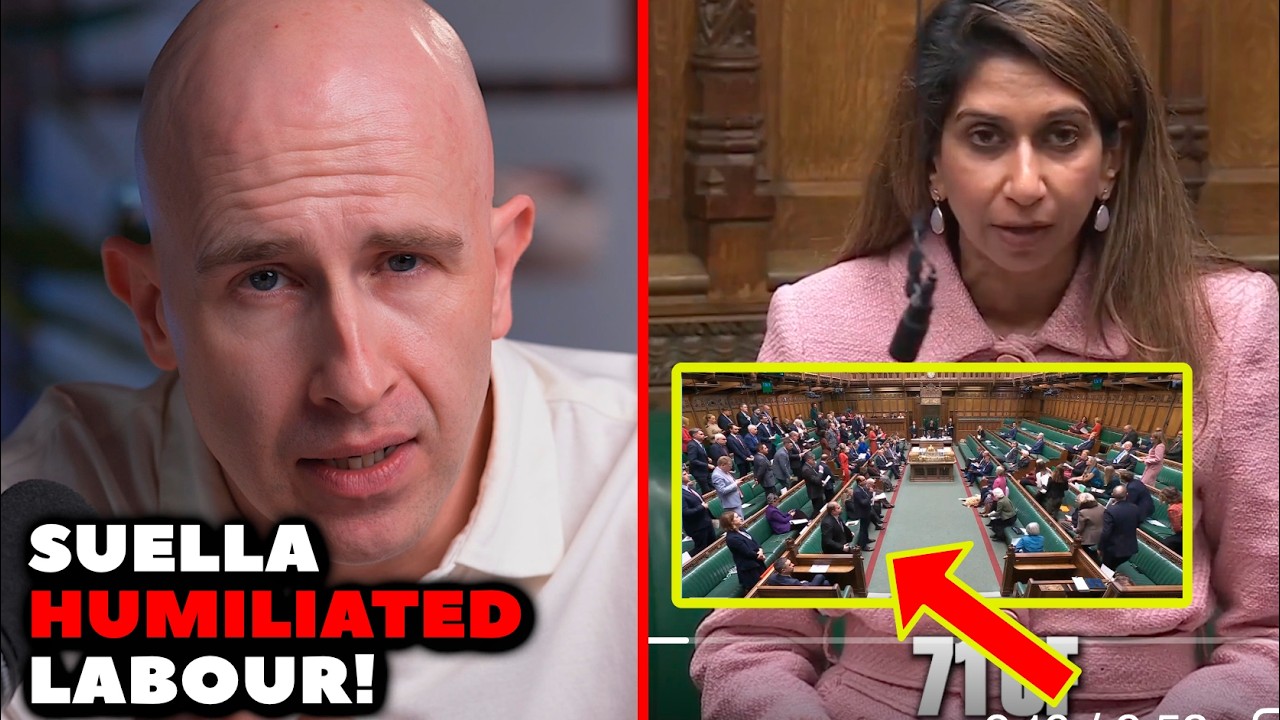
In this analysis, Daniel ShenSmith reviews a recent exchange in the House of Commons where Suella Braverman was heckled by MPs while addressing youth unemployment and migration. Braverman highlighted that domestic entry routes for young people should not be substituted by migration, drawing directly from a government-commissioned review authored by Alan Milburn. Daniel compares her approach to an effective courtroom cross-examination, noting how citing an opponent's own commissioned material undermines credibility when met with reflexive opposition.
The discussion also examines broader government messaging and international agreements. Daniel scrutinises a Cabinet Office video concerning post-Brexit supermarket food costs, pointing out that several showcased products carried British flags denoting domestic origin rather than EU imports. Finally, the post explores the legal mechanics of international treaties and financial penalties, reiterating that the Westminster Parliament remains the supreme lawmaking body capable of making or unmaking any domestic law.
For more from Daniel ShenSmith on related questions, see Addressing the Root Causes of Violence: A Call for Government Action, TURMOIL - YET Another U Turn. The Pressure Mounts on Starmer and this Labour Government, Why Was Bail Granted? Bail Act Tests, CPS Decisions and the Victims' Right to Review, and How can they justify experimenting on children?.
Full Transcript
Introduction
I've said it before and I have to say it again. If ever you wanted evidence that we are being led and governed by a party who, in my opinion, don't really know what they are talking about and don't really know what they're doing, this is it. Because Suella Braverman made a comment about migration and young people getting into employment and she was heckled for it. But when you realise who made the comment, who commissioned the report that it was in, and how therefore it has backfired on this Labour Party, you'll be amazed. But let's listen to the comment. Then I am going to stop it for a bit. We're going to talk about it, but just listen for the heckling. I really want you to pay attention to that. Listen to this.
Suella Braverman: Speaker, migration should not become a substitute for building domestic entry routes for young people. Those are not—
They were drowning her out with their heckling. They didn't want to hear what she had to say because she was criticising migration. She said, just to repeat for emphasis, that migration should not become a substitute for domestic entry routes for young people.
In other words, we shouldn't be replacing the entry into work with migration instead of our young people, our NEETs—not in employment, education or training. The whole thing is getting young people into work. And because she was criticising migration in that respect, she was heckled.
And one or two things before we roll too far in. Firstly, please do support the channel here. I am hopefully a neutral voice of reason and I try to balance things and give you a neutral perspective, arguing both sides, whether I agree with them or not. Some people would like to see me silenced and not talking about these issues, particularly when they are hotly debated topics, whether it be trans activism or religious beliefs. So please do subscribe to the channel to keep this channel going.
Listen again, and then we're going to reveal where it came from. Listen to this.
Suella Braverman: Speaker, migration should not become a substitute for building domestic entry routes for young people. Those are not my words. Those are Alan Milburn's words at page 71 of his report.
The Milburn Report
Did you hear it go quiet when they realised where it came from? Because Alan Milburn wrote this report here, which was commissioned by Labour and Pat McFadden, who you saw at the beginning of this video here. There he is standing up there.
So this is the foreword by Alan Milburn. We'll come to the quotation in a minute. He said: This review has been one of the most important things I've done in my public life. I want to thank the government and the Right Honourable Pat McFadden, who you just saw, for asking me to lead it. The Prime Minister and his ministers have not only supported me but have given me licence to think expansively and radically.
And it's a good job that they did, because further down at paragraph 328, the bit that's highlighted is what Suella Braverman is referring to here. It says: Take migration policy. Managed migration can play an important role in meeting genuine skills needs, but it should not become a substitute for building domestic entry routes for young people. In sectors with large entry-level workforces and high youth detachment, government should examine the scope for linking access to work visas to evidence that employers have first made serious efforts to recruit young people, especially those who are NEET—not in employment, education, or training. The detailed mechanism should be tested against sector needs and the risk of creating unintended labour shortages.
So that bit that Suella Braverman quoted back to the House, and she was heckled for it, proves in my opinion that they hadn't even read this report. Each and every one of them who was heckling Suella Braverman here hadn't even read this report.
Reform UK posted it here and says, "Watch MPs heckle Suella Braverman simply for demanding British youngsters are prioritised over migrants." They heckled her for it because she's criticising migration and how migration could be replacing the jobs of young people, which might be one of the reasons young people are not able to get work.
And again, for emphasis, she was heckled for it, but it was their report. They commissioned Alan Milburn to write this report.
A Cross-Examination Masterclass
Now, this is an absolute masterclass in how to catch someone out. This is exactly what we do in court, which is why all credit to Suella Braverman here, who actually read this report. That's why she's a KC. This is what you do in court. You take something which is created, written, or commissioned by the party you're putting it to, and you feed it back to them, and it absolutely destroys credibility. There's no coming back from that, because they commissioned this report. So surely the very least they could have done was read it. And so if she reads out a small quotation from it, even if it's paraphrased, they should recognise it. They certainly shouldn't heckle her for it.
It's a little bit like one time—it's probably one of my most memorable points in cross-examination in court. There was an exchange of text messages between the two parties, the opposite side being the person I was cross-examining, who'd been sending fairly aggressive messages to my client, words to the effect of: "I will tell the court XYZ," XYZ being false.
My client had replied to that message and said, "But that's not true. You can't tell them that."
And they said, "Well, I will tell the court that, and it won't look very good, will it?"
So we're in court, and of course, I've got these messages, and I just put those messages back. I read them out verbatim to this person I was cross-examining, then finished with this: I said, "Well, now we are in court, and it doesn't look very good, does it?"
Because that is exactly what's going on here: putting back to somebody what they have written or commissioned, that they should know about, they should understand, and clearly they don't. Clearly they haven't read it, don't understand it, and instead they heckle her for it.
Now, the only inevitable conclusion that this leads to is they've heckled Suella Braverman purely because she's criticising migration, which only really, in my opinion, goes to show that this Labour Party are just anti-anybody who's criticising migration for whatever reason.
If there's any doubt in what I'm saying here, just listen to the full clip now. Listen to their heckling, then listen how it dies down when they realise—the "uh-oh" moment—when they realise where it came from, and then what Suella Braverman has to say about it afterwards. I'll leave you to watch it all. Listen to this.
Suella Braverman: Speaker, migration should not become a substitute for building domestic entry routes for young people. Those are not my words, those are Alan Milburn's words at page 71 of his report. As the Secretary of State has not mentioned this elephant in the room, I will ask him whether he shares my concern that according to data from the Centre for Social Justice, for every new extra young Brit working, there are 27 young foreigners working. And will he agree that actually we need to reverse the government's employer's National Insurance rise for British workers so that young Brits are at the front of the queue for new jobs?
And that is an absolutely sensible proposition. We should absolutely be prioritising young British workers, and all of the changes that are detrimental to businesses and detrimental to people in work, particularly young people—and I'll give you some justification for why I say that in a moment—all of these should be reversed, and they should be prioritising British businesses and British workers.
Now, a couple of headline points here. If you make something more expensive to do, then fewer people do it. If you make it more expensive to hire young people or anybody at all, then fewer companies will do it and they will hire fewer people. If when hiring young people it is not any more expensive, but they are likely to be less experienced, less qualified perhaps, and just less value for money for that business than employing somebody who is more experienced and more qualified, then they will employ fewer of those younger people. That is one of the driving factors as to why younger people are struggling to get into work. That is absolutely a no-brainer. That is one of the big reasons why.
Also, as pointed out by Suella Braverman here, for every young Brit trying to look for work, there are 27 migrants looking for work for the same roles. And so she's absolutely right that we should be prioritising young people in that way.
So why then are they heckling her for it without at least hearing her out? One of the things that really irritates me about politics—which is why, ironically, I never wanted to talk about politics and never took an interest in politics, save that I like to know what's going on—is the absolute lack of courtesy, in that they're all talking and heckling and having these little debates and disputes between themselves or overriding what she's saying. At the very least, have the courtesy, when she's talking about young people in Britain trying to look for work, to listen to what she's got to say, and wait a turn if you're going to refute what she's got to say.
And if you're going to refute what she's got to say, at least know where she's quoting it from, and at least read the report first. Nobody can sensibly debate or reject what she's saying here when she's quoting from a report that they commissioned, that they haven't even yet read. It's absolutely disgraceful.
So coming full circle, if this is not evidence that these people don't understand what they're doing and don't know what they're doing, I don't know what is, because they are heckling her for quoting from a report that they commissioned that they haven't even read. What more do you need? Seriously.
We need to be prioritising British workers, British young workers, in the way that she suggests, and to fail to do so is a failure of the British people. I don't know how else to put this. That is not me being partisan. I try to be as fair and balanced as I can on this channel.
When Keir Starmer got into office, I said it sounds like he's trying to do some of the right things. He's certainly saying the right things. For example, you can go back and find my video where I quoted him saying he's not going to try to undo the Brexit vote; he respects that vote. And I said, okay, I'll take that at face value, much like a court would. A court would take those things at face value and say, okay, that's what he's saying. I've no reason to disbelieve him at the moment until he gives me reason to disbelieve him.
But now we've got good reason to disbelieve him because now he's pushing headlong through this EU reset, which I've got more about in a minute, which also shows that they really don't know what they're doing from the Cabinet Office. But they're pushing for this EU reset, which just goes to show: was he lying, or has he just changed his mind, or has he been told to change his mind since he previously said he's not going to go back on the referendum vote, that he respects that vote? His words, not mine.
The Cabinet Office Video and Food Labels
Coming back to why, again, they don't really know what they're doing. This is from the Cabinet Office. This says: "Three days till the UK-EU summit." And there's something about a fine; I'll come back to that in a minute. "Costs in supermarkets," they say, "have gone up since Brexit, partly thanks to unnecessary paperwork. At the summit, the government will agree to slash that paperwork, reducing costs and creating more export opportunities."
Listen to what he's got to say, and then we'll say why, with respect, he doesn't know what he's talking about. Watch this.
...a deal with the EU to get rid of dairy, meat. Oh, actually, yellow sticker. There we go. Eggs and the greens. Why has this got more expensive since Brexit? It's partly because of all this, the quantity of forms that this...
But that's not true. He's talking about the quantity of forms here because he's presumably talking about the import forms and everything else to do with bringing this food into the UK. But why does that not make sense? Because all of the food that he's picked up there, or most of it at least, is British.
This packet of meat that he's holding here, you can quite clearly see is British. It's got the British flag on the front of it. And the next one, he's picked up the greens, as he put it, which has got a British flag on the front of it, indicating the country of origin. And then he's got more stuff in there: the milk in there and the eggs in there and everything else. And they are British produce.
So if he's going to criticise the cost of bringing things into the UK, maybe he should have looked at the labels and at the very least used some examples of stuff that's been brought in from the EU rather than produced in Britain, that is actually costing more because of these EU rules and paperwork. Maybe that would have been more persuasive.
International Treaties and Parliamentary Sovereignty
Finally, as if there wasn't enough insult and injury already, it seems that the EU would like to fine any future government for pulling out of this reset deal. The BBC put it to Richard Tice as to what Reform UK would do if they were to pull us out of any subsequent deal and whether there was any fine. They say this. Listen to this.
BBC: Now, Newsnight has confirmed that once this deal is signed, the UK would have to pay a multi-million-pound fee if a future government pulled out of this deal. If you were to win the next election, would you refuse to pay that fee?
Richard Tice: Of course. Of course. It's ridiculous. You can't bind a future government. They're calling it thuggery. We'll forget it. We'll just rip it up.
BBC: Right. Even though it's a standard clause in any international treaty that works both ways? That works both ways. So if they pulled out, they'd have to pay us.
Richard Tice: They know our position. They know we'd reverse it. So of course we're not going to pay a fee.
A lot of people are asking: what's the position on this?
International treaties only work by agreement. If we don't agree to it, then we don't abide by it. I've held views for a long time now that the original conventions and everything else to do with rescuing people at sea, and so on and so forth, were created for the post-war era where people were genuinely in need of rescue at sea. Only I think now it's being abused, but we are still bound by the same convention and everything else. So I think those need revisiting.
Regarding this one here, if we were to sign some kind of deal with the EU that ostensibly most of the British public don't want—certainly by looking at the poll that I did on here, 26,000 people have voted, and 92% said no, we should stay out and become truly independent. About 5% do say that yes, we'd be better back in the EU, but most people, it would seem, would like us to stay separate, thank you very much.
The EU would now like to say that if we do sign a deal and then a future government brings us out of it, they want to fine us for it. And as Richard Tice said, they'd just rip it up. If any future government did do that, whether it's a Reform government or a Restore government—and I suspect Rupert Lowe would do exactly the same thing—they would just rip it up. And they would say, no, we're not paying that. Why would we pay that?
International treaties and agreements only work by agreement. If we choose that we don't agree to that, then what are they going to do? Sue us? And to who? If we don't agree to it and we don't pay it, that is it.
International law generally works by, firstly, agreement; and secondly, a bit of law that is operational in both countries and remains operational in both countries. It's a little bit like enforcement in multiple jurisdictions. If we've got, let's say, a defamation law in the UK and they've got a defamation law in the United States, and we've got an international cooperation to enforce those laws, fine.
Conversely, that is also why Ofcom has got no chance whatsoever, in my personal view, of successfully suing a US company in the United States for breaching what we consider speech laws in the UK. It's just nonsensical. They are not going to succeed in suing a United States company in the United States in a United States court for a law of England and Wales. It's just not going to work. It's not going to happen. A US court is never going to uphold it because there's that disconnect in the jurisdiction. They don't agree with our laws, and it's that agreement point and principle again and again. If there's no agreement, it doesn't happen.
For the avoidance of doubt, the Westminster Parliament is the supreme lawmaking body in this country. It can make and unmake any law it so chooses. It could repeal the Human Rights Act. It could repeal the Equality Act, whatever it chooses to do. Obviously, it would seek to replace bits of law here and there, but by and large, it can make and unmake any law it so chooses, including treaties that we've previously agreed. We could just make a new law that says we no longer agree to those positions.
A lot of people might get upset by it, but that's just how it is. A lot of people will argue that's a breach of international law, but such as it is. If the Westminster Parliament decides that's what happens, then that's what happens.
Conclusion
Leave me your thoughts and comments below. I thought all of this was very interesting. Do like the video and share the video, and make sure you subscribe to the channel. And as always, thank you for watching.
Introduction
A recent House of Commons exchange involving Suella Braverman highlighted what Daniel ShenSmith describes as governing politicians failing to understand their own materials. During a debate regarding young people and employment, Braverman raised the point that migration should not serve as an automatic substitute for establishing domestic routes into work for British youth.
Her statement was met with immediate heckling from opposing benches. Daniel observes that the reaction seemed targeted at her criticism of migration policy, specifically her point that domestic youths—including those categorized as not in employment, education, or training (NEET)—should not be bypassed. However, the origin of the quotation swiftly altered the dynamic of the chamber.
The Milburn Report
The heckling notably subsided once Braverman disclosed that her words were not her own, but rather a direct citation from page 71 of a report authored by Alan Milburn. The review had been commissioned by the Labour government, with Pat McFadden specifically thanked in the foreword for asking Milburn to lead it.
Paragraph 328 of the report expressly notes that while managed migration can address genuine skill gaps, it must not replace domestic employment pipelines for young people. It further suggests that access to work visas in sectors with significant entry-level positions should be conditional on employers demonstrating prior efforts to recruit domestic youth. In Daniel's view, the initial interruptions revealed that the heckling MPs had not read the findings of the very report their own frontbench had commissioned.
A Cross-Examination Masterclass
Daniel views Braverman's approach as a classic demonstration of court advocacy. In litigation, putting an opponent's own words or commissioned reports back to them serves to dismantle their position. Daniel recalls a memorable cross-examination from his own practice where reading an opposing party's aggressive text messages back to them in the witness box achieved a similar effect.
Braverman proceeded to cite Centre for Social Justice figures suggesting a significant disparity between new foreign workers and domestic young workers, arguing against the employer's National Insurance rise to keep young Britons competitive. Daniel notes that increasing employment overheads naturally discourages businesses from taking on less experienced domestic applicants. Moreover, he criticises the lack of parliamentary courtesy displayed when MPs shouted over her before understanding that the quoted text originated from their own government's policy review.
The Cabinet Office Video and Food Labels
Daniel also addresses government communications regarding post-Brexit trade, specifically a Cabinet Office promotional video previewing a UK-EU summit. The video claimed that supermarket shelf prices had increased post-Brexit largely due to excessive paperwork, which upcoming negotiations aimed to reduce on items such as meat, greens, eggs, and dairy.
Daniel points out a glaring flaw in the presentation: the specific food packages held up to the camera visibly displayed the British flag, indicating domestic origin rather than European imports. If government representatives intend to highlight the adverse impact of border paperwork on consumer goods, Daniel argues they ought to display actual imported European products rather than domestically produced groceries.
International Treaties and Parliamentary Sovereignty
Turning to reports that future UK governments could face financial exit penalties if they withdraw from negotiated EU reset arrangements, Daniel clarifies the legal realities governing international agreements. Responding to political discussions on whether such clauses are binding, he explains that international law fundamentally operates on mutual consent and shared enforcement frameworks.
Daniel draws a parallel with jurisdictional limits, such as domestic regulators attempting to enforce speech rules against foreign entities abroad without jurisdictional agreement. Under domestic constitutional law, the Westminster Parliament is the supreme lawmaking authority. Parliament possesses the inherent power to enact, amend, or repeal any domestic statute—including legislation giving effect to previous international treaties—regardless of potential political fallout or international objections.
Conclusion
These developments underline the importance of thoroughly scrutinising official reports, public statements, and the underlying constitutional framework. To explore these legal topics, evaluate documentary evidence, and access comprehensive legal drafting aids, consider using the templates and legal AI tools available on Black Belt Barrister Pro.
Thank you for reading.