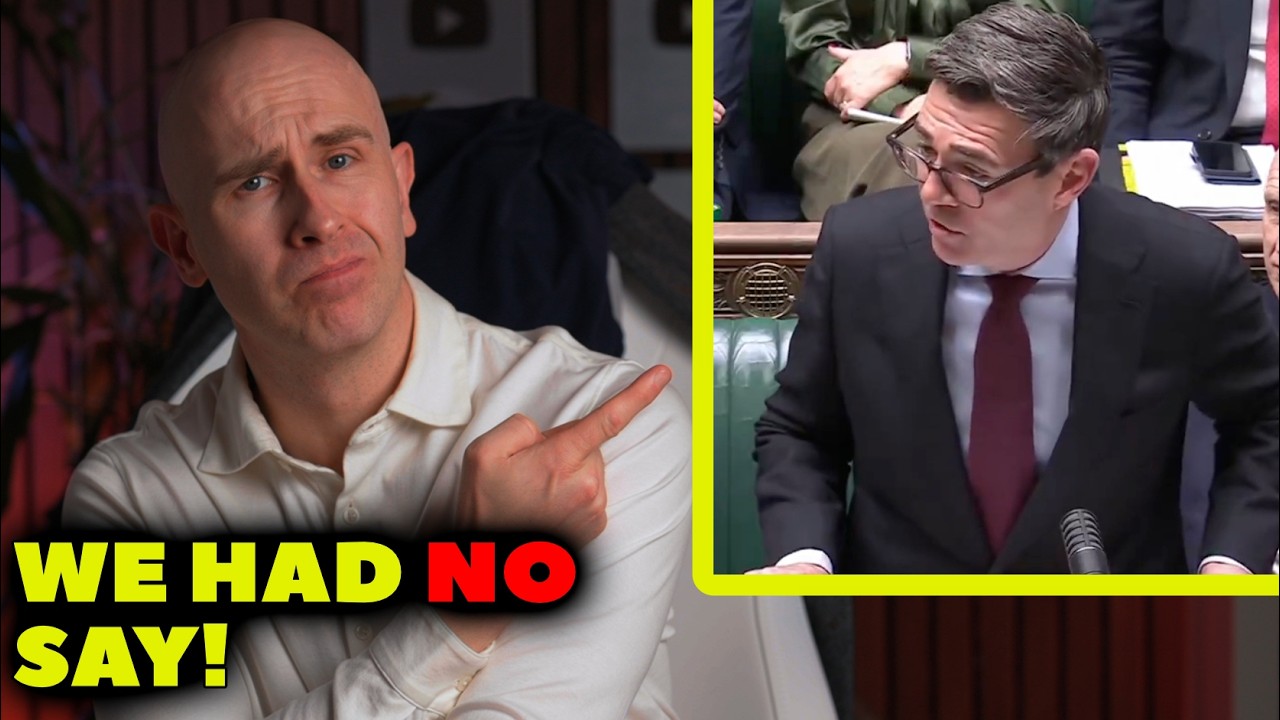
Video Summary
In this analysis, Daniel ShenSmith addresses recent political statements regarding post-Brexit trade and examines the reported reset deal between the UK and the European Union. Despite previous political assurances that the 2016 referendum outcome would not be revisited, the emerging agreement introduces substantial arrangements across multiple sectors.
The discussion explores specific elements of the agreement, including the sudden expansion of the youth mobility scheme, proposed alignment with EU regulations in food and farming without voting rights, and UK financial contributions towards European regional development. Daniel also weighs the projected economic benefits against potential compliance burdens and sovereignty trade-offs.
Finally, the post assesses whether the current administration holds a political mandate for these measures and explains the constitutional position of parliamentary sovereignty, confirming that no government has the power to permanently bind its successors to international treaties.
For more from Daniel ShenSmith on related questions, see The CPS is Gunning to Destroy Your Rights, A Barrister's Money Checklist: Tax Refunds, Pensions, and Consumer Rights, Know Your Rights: Navigating Police Encounters in England and Wales, and Coming for YOUR Rights ....
Full Transcript
Introduction
Our Prime Minister, Andy Burnham, on Wednesday at Prime Minister's Questions, said something that was simply not true.
He said that our trade with the EU had declined since Brexit, but it's simply not true.
Exports are down from their constituencies, and they know that. They know that as well.
But presumably he said that in support of his efforts today to do this deal, this reset deal with the EU, despite all the while saying that he's not going to go back over the referendum vote to leave the EU for Brexit in 2016, that's what they've done now. They've essentially signed this deal, which I'm going to go over in a minute. But on Wednesday, he said this, which was simply not true.
Have a listen to this as to why.
It takes us backwards, and they'll argue, "Oh, Brexit hasn't worked." Do you know, yesterday in the House of Commons, the Prime Minister said something in PMQs that was not true. Wasn't true. He said our trade with Europe had declined since Brexit. It is not true.
Our overall trade with the EU is up since Brexit, especially in services.
And where we've diverged on bits of financial services, AI, research and development, gene editing, agritech, as that business is called, where we've diverged, we're booming. The reason we had a good growth figure last week was because of those areas where we've got away from this very backward, outdated economic model. Divergence is our strength.
And not only do I think that he wasn't being truthful in the House of Commons on Wednesday, I think as a nation we've been misled for some time. I'll tell you why. Because just like how Number 10 North popped into existence out of nowhere when he became Prime Minister, and that must have been under progress for some time, it didn't just come out of thin air.
This deal with the EU certainly hasn't come out of thin air. It took years of negotiation to go through Brexit. Lots and lots of paperwork and meetings. It took a lot of time, a lot of money, and for what it's worth, I voted Remain. So this is coming from somebody who voted Remain. I thought to myself, let's not try to unravel all of this because they will make a mess of it.
So I voted Remain. But that aside, the referendum voted that we leave. Then we spent a lot of time, a lot of money, a lot of effort to separate us. And actually, we've been doing all right since then. But again, with great respect, I think a lot of people don't fully understand how this is going to affect so many people and how the EU is going to take control of this country in many different ways. And I don't think that's a good thing.
So before we get too far ahead of ourselves, it is things like this that people like to shut down voices like mine and channels like mine. So please do subscribe to the channel in support of free discussion on these things. Yes, I am a barrister and I frame this as legal education, and I hope that it is of use to you. So please do subscribe, and I'm very grateful. I say that because some people don't like that I call it legal education, but it is. I don't know what else to call it. That's what it is. That's what I call it anyway. So thank you.
The Brexit Mandate and the Reset Deal
So let's look at Brexit, shall we? And this EU reset deal which has now apparently been done, except there's a few other things that the EU is going to bash us over the head with.
Firstly, looking at the Brexit vote, that was about democracy in the first instance. It was democratic control. Because the 2016 referendum was more than just immigration and trade. It was a central principle. Again, this is coming from someone who voted Remain, remember. It was a central principle and a referendum which voted in favour of restoring control over British laws, British borders, our own public spending, and a separation from the EU so that we could still trade with them if we wish to, but we were to be separate. Those who voted for Brexit knew that there'd be some kind of trade-off in exchange for greater independence, greater sovereignty, control of our own laws and borders and everything else.
That's what people voted for. So the key question here is, now with this reset deal, how much of that, how much of what people voted for are we now being asked or forced to surrender for this deal with the EU? And we don't know. The biggest problem with all of this is the lack of transparency, because very often when it involves what we have to give them, what we have to do, what we have to surrender, very often the detail is left wanting. We are not told everything. There is a distinct lack of transparency.
Youth Mobility and Reciprocity
Now, when we talk of the youth mobility, Britain's initial proposal was reportedly to allow 50,000 places annually. This has now apparently just doubled overnight with no real explanation as to why. The agreement apparently has 100,000 with stays of up to three years.
Now, the government will emphasise the positives, which it says are opportunities for young British people to live and work in Europe, but there's no explanation as to why that number suddenly doubled. Moreover, there's no explanation as to what concession we were given in exchange for doubling these numbers. There's no explanation of what we get in return. We're just told to accept 100,000. And so again, the key question is one of transparency and perhaps reciprocity. What do we get in return? Or have we just been trampled on and we've just had to accept what we're told?
Regulatory Alignment Without Representation
Then, of course, there's the laws and the rules, and do we get an EU vote? Well, of course not, because if we're not an EU state, we don't get a vote. They've said thus far that we get a say and we get some kind of contribution, but we don't actually get a vote and we don't actually get a say on what really happens at the end. But in the meantime, we are required to follow the rules and the laws.
The proposed food and farming agreement would require alignment with all of the relevant EU regulations. This would include future regulatory changes that we've not yet seen, not yet agreed to, not just the existing rules. And we wouldn't get a say in what those new rules are, of course. British businesses serving domestic customers—so it's a British business serving British people—would have to follow these EU rules that are not made here, not debated here, not voted on here. And we don't get a say in what any of those are as they are made in the EU. Britain might be consulted on the changes, but we'd have no formal vote in the EU making those rules.
So the key questions here are: what practical value do our British businesses get if we still have to follow those rules that we've got no real say in making? And what practical value is there in being independent yet still having to follow the rules? It just doesn't make sense, and this is what they are not talking about. Again, it is something that they know that they just don't have to talk about. Most people won't ask about it. Most people won't know about it. People are just too busy going about their daily lives, and therefore won't be in a position to ask these questions and certainly not question the decisions being made. We just get no say in this at all.
Contributions to EU Regional Development
Then we get British taxpayers having to contribute to EU regional development. Again, we are going to be financially contributing to EU development.
This joint statement looks at a UK financial contribution connected with future electricity development under this agreement, whilst we already have our own issues with the cost of power here and the debate all around that. But wait till you hear what this is for: this financial contribution from the UK to the EU is to reduce the economic disparity between other EU states, EU regions. So we would be paying to assist the change in the disparity, to reduce the disparity, the difference between other EU states and what they pay for power.
How is that possibly going to improve things for us? Genuine question. Because I don't see how it is. I don't see how British people benefit from this contribution to change this disparity between other EU regions. The key question: why should British taxpayers contribute to EU regional development, and what measurable benefit would there be for us? I don't know, because they are not really telling us.
Projected Economic Benefits Versus Reality
Next, we are told that there are economic benefits projected, that we are projected to increase our GDP. But remember, firstly, it's merely a projection. Secondly, which should concern you even more, it is a projection by this government who on the face of it doesn't really understand business, and there's no real evidence behind the assumptions made on this forecast. The forecast is made dependent on these assumptions, not established economic facts or established economic outcomes.
So any benefit is going to be weighed against what we have to pay them, what we lose in return, and what it costs us in return to comply with the laws and the rules and everything else. And the big question at the end of it is: does all of that justify the cost, or do we end up net negative? I think I can predict where we might end up.
The Political Mandate and the Makerfield Promise
There's two more things, one of which is the mandate. A lot of people are saying that there is no mandate for Andy Burnham to do this. There is weight in that argument, certainly as a political argument. Secondly, what can we do about it afterwards? We'll come to those in turn.
Firstly, there is the glaringly obvious elephant in the room that Andy Burnham assured his Makerfield voters when he became PM in Makerfield that he would not reopen the Brexit argument. He said he didn't want to go back over that. He didn't want to redo the referendum. And yet here we are, just like I predicted, six months later, this government has now reportedly signed this EU deal, this reset deal, which is the undoing of Brexit in all but name in my personal opinion.
To be fair and balanced about all of this, which I always aim to be on this channel, supporters will say that governments routinely make international agreements and trade deals with other countries, and this is nothing different than that. But at the same time, critics will say: did he not mislead the people of Makerfield when he promised them that he was not going to undo the Brexit vote and that he wasn't going to unravel all of that when he became PM and was sort of parachuted in by virtue of his vote into MP in Makerfield? I think people will feel misled. That's my personal opinion.
At the same time, he says that three-quarters of the UK would prefer to go back into the EU. I'm not so sure that's true. If it is true, and I stand to be corrected, throw it to a referendum, and then we'll find out. I suspect it won't be anywhere nearly as high as three-quarters. It may tip in favour of rejoining the EU, but we won't know unless we do a new referendum. They did it to leave. If we're going to do something so serious as to rejoin, which is going to affect everybody, why not do another referendum to see what people think?
I know why. Because they are terrified that the vast majority will say, "No way, we're not rejoining the EU," and then they'll sort of have to follow it, like they sort of had to follow Brexit. I say that because we did go through Brexit, but it wasn't the true Brexit that we were promised and that it was really supposed to be. Again, I remind you, this is coming from someone who voted Remain.
Parliamentary Sovereignty and Future Governments
The final thing is, what can a future government do about all this? Can this government bind a future government?
In short, no, they can't. The one thing that any government cannot do is bind a future government. The Westminster Parliament is the supreme law-making body of this country. It can make and unmake any law that it so chooses. And that includes, for the avoidance of doubt, international agreements, trade deals, and treaties and everything else. Because an international law is only really two countries agreeing what the law is and they both agree to follow it. If one country suddenly changes and says, "Actually, no, we're not following that anymore," they can do so. Yes, other countries might be upset by it if we pull out of a convention or a trade deal or a treaty or something else. They'll be upset by it, but these things are not written in stone. Westminster Parliament can make and unmake any law that it so chooses.
I personally believe if we get a Reform UK government or a Restore Britain government that they would undo this deal and restore our sovereignty. Not so sure about the Conservatives. Maybe people have thoughts to leave in the comments. Maybe they will, maybe they won't. I'm not really sure. But one thing for sure is no government can bind a future government.
Conclusion
Throughout all of this, my biggest problem, the one thing that does make me frustrated, is that I feel that we've been misled. I feel that they are not being transparent with us. I do feel that this has been negotiated in the background in secret for many weeks, if not months, leading up to this point. There's no way that this happened this week or even in the last few weeks. There's just no way that happened, in my personal view. I think it's been weeks and months in the making. They knew it all along. Maybe they knew it before Andy Burnham was voted in in Makerfield. Who knows? I don't really know because they're not being transparent about it.
I would like to know. I think the British public deserve to know, and at the very least, if we are being required to follow EU rules like this, we deserve to know the truth.
Just my thoughts, for what it's worth. Leave me your thoughts in the comments box below. Do like the video, subscribe to the channel. We're almost there at 1 million subscribers. I've been plugging away literally daily for six years now, so I really do appreciate you subscribing. It is free, by the way. Some people think you have to pay; it is free down below. Make sure you don't unsubscribe in the process, although I think that's difficult, but also check you are still subscribed because YouTube does this thing of unsubscribing people randomly for some reason. I don't know why it does that. It's sort of swimming against the tide for me, but that's why I keep asking. It's the difference between 20 people subscribing and 200 people, so it really makes a big difference. Subscribing does help the channel; it helps to spread it to a wider audience. So thank you so much. Have a great weekend and I'll see you in the next one.
Introduction
Daniel ShenSmith begins by addressing claims made by Prime Minister Andy Burnham during Prime Minister's Questions regarding post-Brexit trade with the EU. Burnham asserted that trade had declined since Brexit; however, Daniel disputes this assertion. Citing overall trade figures, Daniel highlights that trade with the EU has actually increased since leaving, particularly across the services sector. Furthermore, in areas where the UK has diverged from EU regulations—such as financial services, artificial intelligence, research and development, gene editing, and agritech—the economy has seen substantial growth, illustrating the benefits of regulatory independence.
Daniel expresses concern that the public has been misled regarding the nature and duration of negotiations. Much like the sudden establishment of Number 10 North, Daniel suggests that the newly announced reset deal with the EU could not have emerged out of thin air. Having personally voted Remain in 2016 to avoid the costly and complex process of unravelling existing ties, Daniel notes that the referendum result was definitive. Years of extensive meetings, paperwork, and expenditure were devoted to separating the UK from the bloc. Despite managing relatively well post-departure, Daniel warns that entering into this new deal risks allowing the EU to regain significant control over the country without adequate public awareness.
The Brexit Mandate and the Reset Deal
The 2016 referendum was fundamentally about democratic control and restoring sovereignty. It extended far beyond narrow arguments regarding immigration and trade; voters chose to restore national authority over British laws, borders, and public spending. Even as a Remain voter, Daniel acknowledges that the electorate understood there would be trade-offs in pursuit of greater constitutional independence.
The critical issue with the new reset deal is determining precisely how much of that democratic mandate is now being surrendered. Daniel highlights a distinct lack of transparency from the government, noting that the finer details of what the UK must concede or give up to the EU are consistently withheld from the public.
Youth Mobility and Reciprocity
A clear example of this lack of clarity is found in the youth mobility arrangements. The UK's reported initial proposal intended to cap places at 50,000 annually. However, that figure appears to have doubled overnight to 100,000 places, allowing stays of up to three years, without any public explanation for the adjustment.
While the government promotes the scheme as an advantageous opportunity for young British citizens to live and work across Europe, it fails to outline what reciprocal concessions were secured in exchange for doubling the quota. Daniel questions whether the UK received any tangible benefit in return or simply accepted demands without negotiation.
Regulatory Alignment Without Representation
The deal also raises serious legal questions regarding ongoing regulatory alignment. Because the UK is no longer an EU member state, it possesses no formal vote in EU institutions. Although the UK may be consulted on matters, it retains no power to decide the final shape of European legislation, leaving the country subject to rules it cannot influence.
Under the proposed food and farming agreement, the UK would be required to align with existing regulations as well as future regulatory changes that have not yet been drafted or scrutinised domestically. Consequently, British businesses catering solely to the domestic market would be forced to follow rules created overseas. Daniel argues that this arrangement undermines the practical value of independence, leaving businesses compliant with external mandates while enjoying zero democratic say.
Contributions to EU Regional Development
In addition to regulatory burdens, the joint statement outlines financial obligations requiring British taxpayers to contribute to EU regional development funds. This contribution is linked to future electricity development agreements, introduced at a time when domestic consumers in the UK are already grappling with high energy costs.
Critically, Daniel points out that these UK funds are earmarked to reduce economic disparities between different EU regions and assist with their electricity price differences. Daniel questions the justification for spending British tax revenue to subsidise development between EU regions, highlighting the complete absence of any measurable return or benefit for the British public.
Projected Economic Benefits Versus Reality
The government defends the reset deal by pointing to forecasts suggesting an eventual increase in national GDP. Daniel cautions that these figures remain mere projections, resting upon speculative assumptions rather than proven economic outcomes. Given the administration's questionable commercial understanding, these forecasts should be treated with scepticism.
Any projected growth must be balanced against the direct costs of compliance, ongoing financial contributions, and lost regulatory autonomy. Without accounting for these liabilities, Daniel questions whether the arrangement will yield a net benefit or leave the country in an economically negative position.
The Political Mandate and the Makerfield Promise
A major political concern surrounding the agreement is the question of a legitimate mandate. When Andy Burnham was elected in Makerfield and assumed office, he expressly promised his constituents that he would not reopen the Brexit debate or seek to unpick the referendum outcome. Yet, within months, a comprehensive deal has been agreed that Daniel considers an undoing of Brexit in all but name.
Balancing this perspective, Daniel notes that defenders would argue governments regularly execute trade treaties as part of ordinary foreign policy. Nevertheless, critics and local voters may well feel misled by the rapid departure from earlier pledges. Burnham has claimed that three-quarters of the country wishes to rejoin the EU—an assertion Daniel doubts. Daniel suggests that if the government genuinely believes the public desires a return to the EU, the issue ought to be put to a new national referendum rather than agreed piecemeal behind closed doors.
Parliamentary Sovereignty and Future Governments
From a constitutional perspective, the agreement cannot permanently bind the United Kingdom. Daniel emphasises the foundational principle of parliamentary sovereignty: the Westminster Parliament remains the supreme law-making authority in the country and cannot be bound by previous administrations. It holds the constitutional right to make or unmake any law it chooses.
This authority extends directly to international treaties, trade agreements, and bilateral accords. Because international law relies on mutual assent, a sovereign state retains the legal power to withdraw or repeal legislation if it chooses to do so, regardless of international diplomatic friction. Daniel suggests that future administrations—such as a potential Reform UK or Restore Britain government—could exercise this sovereignty to unilaterally repeal the reset deal and restore independent control.
Conclusion
Daniel concludes by reiterating his concern over the lack of transparency throughout the process. He expresses the view that negotiations were likely taking place behind closed doors for weeks or months without public scrutiny, conflicting with earlier political assurances. The British electorate deserves full disclosure and honesty regarding any arrangements that impose foreign rules and financial commitments upon the nation.
To examine these complex constitutional and legislative issues in detail, consider utilising the legal AI tools and document templates available on Black Belt Barrister Pro, which are designed to help you research and navigate significant legal developments independently. Thank you very much for reading.